Premium Phosphosite-Specific 7TM Antibodies
Your Resource for GPCR Research
Select Your Country of Delivery below

M1 Muscarinic Acetylcholine Receptor Antibodies
Close filters
No results were found for the filter!
NEW
Agonist-induced Serine298 phosphorylation of the M1 Muscarinic Acetylcholine Receptor
pS298-M1 (phospho-M1 Muscarinic Acetylcholine...
Serine298 is a major phosphorylation site of the M1 muscarinic acetylcholine receptor. The pS298-M1 antibody detects phosphorylation in response to high-efficacy agonists.
375.00 € *
NEW
Immunohistochemical identification of M1 Muscarinic Acetylcholine Receptor in hippocampus
M1 (IHC-grade), M1 Muscarinic Acetylcholine...
The non-phospho-M1 receptor antibody is directed against the 3rd loop of human M1 Muscarinic Acetylcholine Receptor (M1). It can be used to detect total M1 receptors in Western blots independent of phosphorylation. The non-phospho-M1...
375.00 € *
NEW
 Validation of the M1 Muscarinic Acetylcholine Receptor in transfected HEK293 cells
M1 (non-phospho-M1 Muscarinic Acetylcholine...
The non-phospho-M1 receptor antibody is directed against the 3rd loop of human M1 Muscarinic Acetylcholine Receptor (M1). It can be used to detect total M1 receptors in Western blots independent of phosphorylation. The non-phospho-M1...
375.00 € *

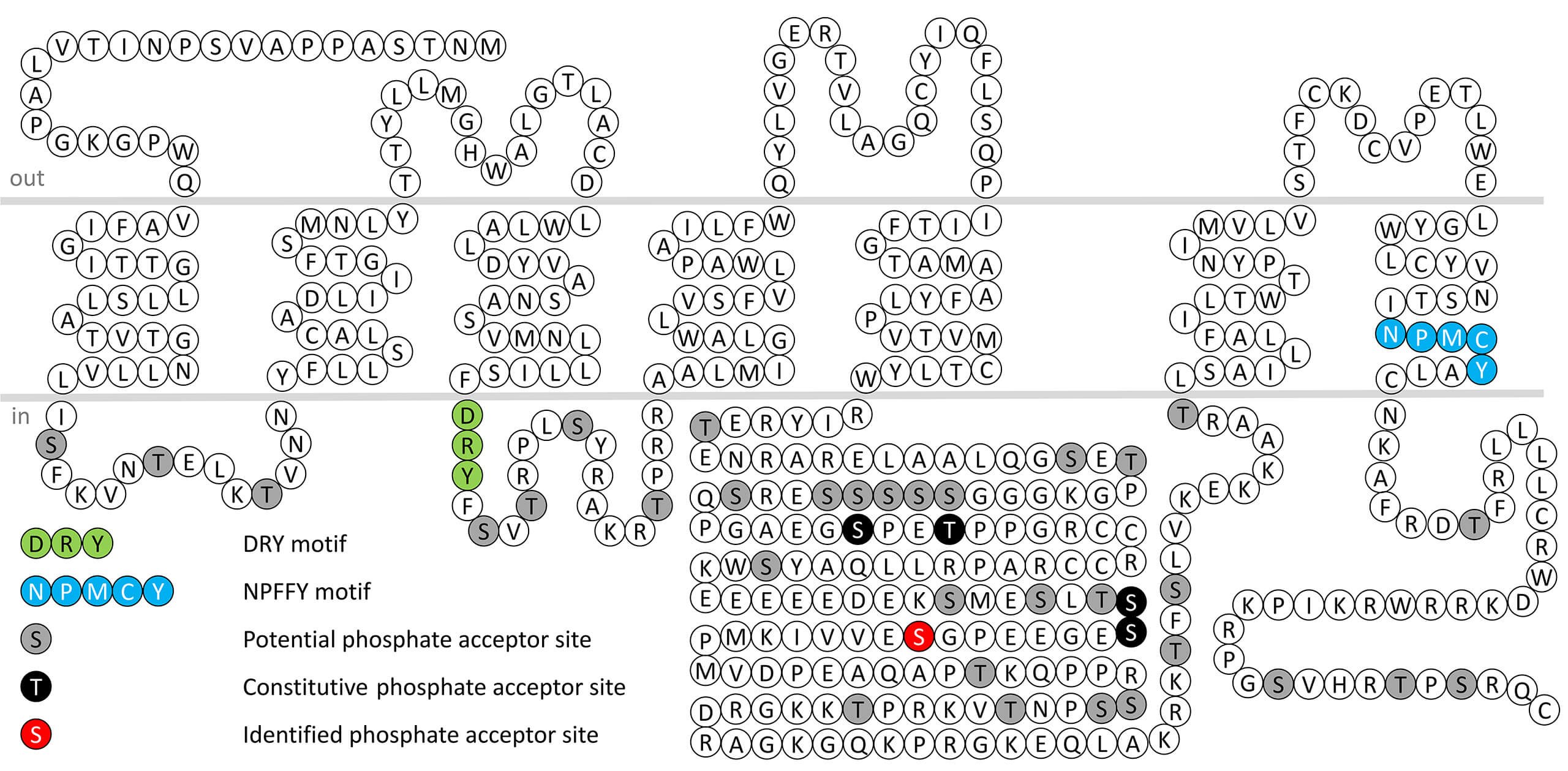
The M1 muscarinic acetylcholine receptor, encoded by the CHRM1 gene, is a G protein-coupled receptor predominantly expressed in the cerebral cortex, hippocampus, and striatum, where it plays a critical role in cognition, learning, and memory. Upon activation, M1 receptors primarily couple to Gq/11 proteins, stimulating phospholipase C signaling and increasing intracellular calcium levels. M1 receptor expression is regulated by developmental stage, neuronal activity, transcriptional control, and receptor desensitization mechanisms involving phosphorylation and internalization. Dysregulation of M1 signaling has been implicated in neurodegenerative and neuropsychiatric disorders, including Alzheimer’s disease and schizophrenia. Consequently, M1 receptors have emerged as promising therapeutic targets for cognitive enhancement. Several selective M1-positive allosteric modulators (PAMs) and agonists have been developed, although many remain in clinical trials. One notable example is emraclidine (CVL-231), an M1-selective PAM currently under clinical investigation for schizophrenia. Additionally, xanomeline, an M1/M4-preferring agonist, has demonstrated clinical efficacy and was recently approved in combination with trospium for the treatment of schizophrenia, highlighting the therapeutic potential of targeting M1 receptor signaling. M1 receptor activity is regulated by phosphorylation of serine298 in the 3rd intracellular loop. This nomenclature refers to the human M1 but is highly conserved in mice and rats. For more information on M1 receptor pharmacology please refer to the IUPHAR database. For further reading refer to:

Caulfield MP, Birdsall NJ. International Union of Pharmacology. XVII. Classification of muscarinic acetylcholine receptors. Pharmacol Rev. 1998 Jun;50(2):279-90. PMID: 9647869.

Wess J, Eglen RM, Gautam D. Muscarinic acetylcholine receptors: mutant mice provide new insights for drug development. Nat Rev Drug Discov. 2007 Sep;6(9):721-33. doi: 10.1038/nrd2379. PMID: 17762886.

Birdsall NJM, Bradley S, Brown DA, Buckley NJ, Challiss RJ, Christopoulos A, Eglen RM, Ehlert F, Felder CC, Hammer R, Kilbinger HJ, Lambrecht G, Langmead C, Mitchelson F, Mutschler E, Nathanson NM, Schwarz RD, Thal D, Tobin AB, Valant C, Wess J. Acetylcholine receptors (muscarinic) in GtoPdb v.2021.3. IUPHAR/BPS Guide to Pharmacology CITE. 2021; 2021(3).

The M1 muscarinic acetylcholine receptor, encoded by the CHRM1 gene, is a G protein-coupled receptor predominantly expressed in the cerebral cortex, hippocampus, and striatum, where it plays a... read more »
Close window
M1 Muscarinic Acetylcholine Receptor Antibodies

The M1 muscarinic acetylcholine receptor, encoded by the CHRM1 gene, is a G protein-coupled receptor predominantly expressed in the cerebral cortex, hippocampus, and striatum, where it plays a critical role in cognition, learning, and memory. Upon activation, M1 receptors primarily couple to Gq/11 proteins, stimulating phospholipase C signaling and increasing intracellular calcium levels. M1 receptor expression is regulated by developmental stage, neuronal activity, transcriptional control, and receptor desensitization mechanisms involving phosphorylation and internalization. Dysregulation of M1 signaling has been implicated in neurodegenerative and neuropsychiatric disorders, including Alzheimer’s disease and schizophrenia. Consequently, M1 receptors have emerged as promising therapeutic targets for cognitive enhancement. Several selective M1-positive allosteric modulators (PAMs) and agonists have been developed, although many remain in clinical trials. One notable example is emraclidine (CVL-231), an M1-selective PAM currently under clinical investigation for schizophrenia. Additionally, xanomeline, an M1/M4-preferring agonist, has demonstrated clinical efficacy and was recently approved in combination with trospium for the treatment of schizophrenia, highlighting the therapeutic potential of targeting M1 receptor signaling. M1 receptor activity is regulated by phosphorylation of serine298 in the 3rd intracellular loop. This nomenclature refers to the human M1 but is highly conserved in mice and rats. For more information on M1 receptor pharmacology please refer to the IUPHAR database. For further reading refer to:

Caulfield MP, Birdsall NJ. International Union of Pharmacology. XVII. Classification of muscarinic acetylcholine receptors. Pharmacol Rev. 1998 Jun;50(2):279-90. PMID: 9647869.

Wess J, Eglen RM, Gautam D. Muscarinic acetylcholine receptors: mutant mice provide new insights for drug development. Nat Rev Drug Discov. 2007 Sep;6(9):721-33. doi: 10.1038/nrd2379. PMID: 17762886.

Birdsall NJM, Bradley S, Brown DA, Buckley NJ, Challiss RJ, Christopoulos A, Eglen RM, Ehlert F, Felder CC, Hammer R, Kilbinger HJ, Lambrecht G, Langmead C, Mitchelson F, Mutschler E, Nathanson NM, Schwarz RD, Thal D, Tobin AB, Valant C, Wess J. Acetylcholine receptors (muscarinic) in GtoPdb v.2021.3. IUPHAR/BPS Guide to Pharmacology CITE. 2021; 2021(3).
Recently viewed